
Musings on how to overcome the fear of immortality.
Click the accessibility icon  for font size and other readability options!
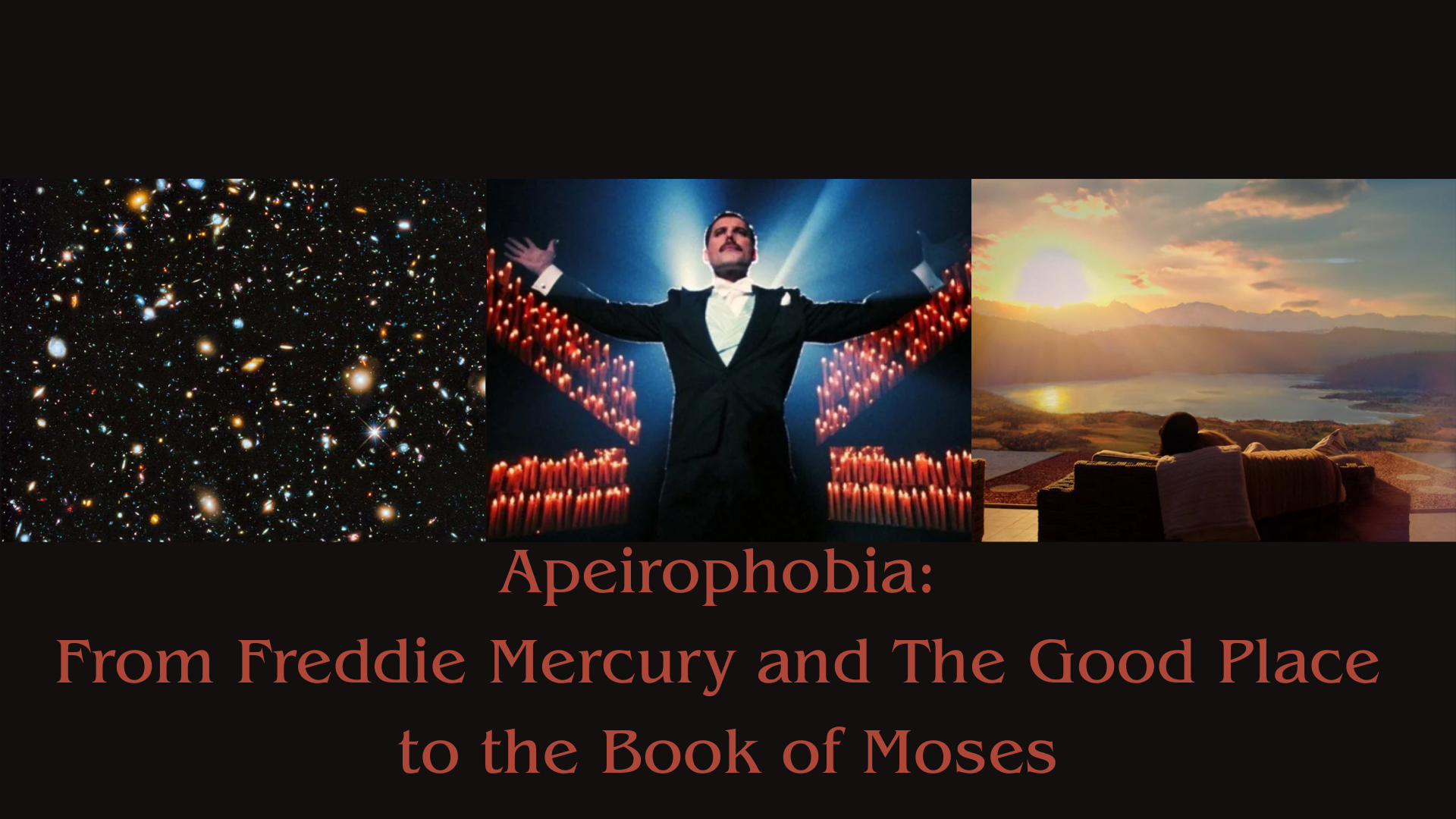
My father raised me with a love of Jesus Christ and classic rock.
I grew up hearing many of the types of gospel sermons that believers around the world are familiar with about the great plan of salvation. The book of Job tells us that “though after my skin worms destroy this body, yet in my flesh shall I see God.”[1] Paul commends the Romans who are “seek[ing] immortality [and] eternal life.”[2] John the Revelator sees the vision of the One who “liveth, and was dead; and . . . [is] alive for evermore.”[3]
I was probably ten years old the first time that, trying to fall asleep at night, I really thought of these and other lessons. Living forever.
Forever.
I only recently learned that there is a name for the intense feeling of anxiety that comes with the thought of eternity: Apeirophobia. Somewhat counterintuitively, this fear of never dying is associated with thanatophobia, which is the fear of dying.[4]
The sick feeling in the stomach of ten-year-old me at the thought of perpetual existence isn’t something that I grew out of in the following two decades. I’d be lying if I said that I don’t feel a little bit of it at the time of writing.
I take some comfort in knowing that I’m not alone. Take my dad’s music: by the time I was ten, I was familiar with Freddie Mercury and Brian May of Queen singing a haunting ballad called “Who Wants to Live Forever?” That seems like a kind of odd thing to sing about, right?
On the television screen, I saw characters like Wolverine and Captain Hector Barbossa lamenting the woes of extremely long lifetimes. Those cases all made a little more sense, as the loved ones around them didn’t have the same blessing/curse of immortality. But then take the more applicable example of The Good Place, a smart sitcom set in the afterlife.
(Major spoilers ahead, you’ve been warned)
The characters, after working themselves out of “The Bad Place” (hell) and into “The Good Place” (heaven), run into the quandary that lies at the root of Apeirophobia: does endless life always end in boredom? How many consecutive perfect days can you have before they stop being perfect?
Different people have different ideas of what heaven looks like. To be honest, scripture doesn’t give a lot of specifics beyond the basic concept of endless happiness and praising God. John the Revelator again gives my favorite description, which is “God shall wipe away all tears from their eyes; and there shall be no more death, neither sorrow, nor crying, neither shall there be any more pain: for the former things are passed away.”[5]
It is comforting and hopeful but, again, sparse on details and extremely hard to comprehend.
The writers of The Good Place solve this dilemma by saying that heaven is about having enough time with the people you love before you pass through a door that ends your existence. It felt like a bit of a weak ending for a show that took on such big topics, if I’m being quite honest, to make the afterlife just Life 2.0 that ends when you want it to end rather than when Kristen Bell gets hit by a semi truck.
It’s something that all believers are prone to, though, projecting our mortal viewpoints onto eternal things. I love my dogs, so my view of a perfect happiness in heaven obviously includes my dogs; my wife, however, might think that we ended up in “The Bad Place” if she is greeted by sheepdog kisses on the other side.
Being mortal means that we are constantly reminded of time. One of my very favorite movies is Interstellar, which plays with the concept of time. After watching the movie, I bought a book called From Eternity to Here: The Quest for the Ultimate Theory of Time, which explains the science of time. You don’t typically go to law school if you’re good at science/math, so I only made it through about a third of the book before finding it well beyond my understanding, but the basic concept is that humans only experience time in an unidirectional linear pattern. We’re all on a one-way conveyor belt moving from now towards the future, one second at a time.
You don’t have to understand the science to get that. None of us are getting any younger, and next Christmas will be here faster than you can believe. With luck, you get seventy-five summers. Gray hairs and sore backs serve as memento mori and we try to plan accordingly.
You would think that the idea of a life without deadlines and death dates would serve as a comfort, so why is it so incomprehensible and, in my case, nauseating?
Let’s go back to my father. He raised me not only with a belief in Jesus Christ, but a belief in modern-day prophets and additional scripture to those I quoted above. Joseph Smith, a prophet of the 1800s, famously translated a work of scripture called The Book of Mormon. Less widely known are some of Joseph’s other writings and revelations, including additional writings of the ancient prophet Moses. In this Book of Moses, Moses “saw God face to face, and he talked with him[.]”[6] As is told in the more widely known second book of Moses (which the Old Testament calls “Exodus”), “there shall no man see [God], and live.”[7] Like Peter, James, and John at the Mount of Transfiguration[8], a physical change had to come upon Moses so that he could “endure [God’s] presence.”[9] In this changed state, God introduced Himself as “the Lord God Almighty, and Endless is my name; for I am without beginning of days or end of years; and is not this endless?”[10]
Ah-ha. No end to years? We’re getting to the stuff that scared me when I was ten. Let’s keep looking at this specific encounter.
God tells Moses “I will show thee the workmanship of mine hands; but not all, for my works are without end, and also my words, for they never cease.”[11]
Right away, we learn that God isn’t just talking about endless time, but endless creations. Endless matter? Don’t try to wrap your head around that one just yet, because God tells Moses “No man can behold all my works, except he behold all my glory; and no man can behold all my glory, and afterwards remain in the flesh on the earth.”[12]
And so, even in this holier, transfigured state, Moses is not shown all of God’s creations. Why? Because that would require seeing all of God’s glory which expressly precludes you from continuing to live on this Earth. Instead, Moses is shown “the world and the ends thereof,” which caused him to “mavel[] and wonder[]” while in the transfigured state, and to fall on the ground “for many hours before [he] did again his natural strength” once he was out of the transfigured state.[13] “For this cause I know that man is nothing, which thing I never had supposed.”[14]
After some time, Moses is once again transfigured and shown another vision, where he “beheld the earth . . . and there was not a particle of it which he did not behold, discerning it by the Spirit of God.”[15] He saw people as “numberless as the sand upon the sea shore” and “many lands[.]”[16] Although Moses is told that God has created “worlds without number,” Moses is again only shown “an account of this earth[.]”[17]
Worlds without number? Here comes that same feeling again, that failure to wrap my head around eternity. But here also is the key.
God tells Moses that the worlds He created are “innumerable . . . unto man; but all things are numbered unto me, for they are mine and I know them.”[18] Similarly, “The heavens, they are many, and they cannot be numbered unto man; but they are numbered unto me, for they are mine.”[19]
I realize that we’ve come a long way from Freddie Mercury and The Good Place.
I also realize that I just quoted a lot of scripture.
If you haven’t pieced together the conclusion to this thought piece, I’m afraid you’re going to be upset with me.
I’ll break it to you slowly, starting with a surprisingly clear and concise verse of scripture from Isaiah in the Old Testament:
“For as the heavens are higher than the earth, so are [God’s] ways higher than [our] ways, and [God’s] thoughts than [our] thoughts.”[20]
Why can the thought of eternal, endless life, of an endless stream of tomorrows, be so scary?
Because our mortal minds literally cannot comprehend it.
During one episode where I was beset by the anxiety of apeirophobia, I soothed myself by picturing myself sitting like Buddha beneath the bodhi tree meditating, trying to perceive the subatomic makeup of every atom that makes up our world, then expanding that outward into the vast cosmos. That would sure take a big chunk out of eternity, right?
But no. That is still thinking of time as something to be measured, something that I will need to somehow fill from one minute to the next. Moses perceived all of the Earth, was shown people more numerous than the grains of sand on the sea, and was still told that he could not perceive all of God’s creations and still live.
We can’t grasp the concept because we can’t grasp it. Just as we can’t breathe underwater or turn around and move backwards on the moving sidewalk of time, it is a limitation of the human body.
The only victory against apeirophobia is to admit defeat and appreciate the beauty of the mysteries of God.
Like Job, we can all admit that we are worm fodder and all have faith and hope for that great day when we are brought into God’s presence, no longer prohibited from beholding His full glory. Through that glory, we will all begin to comprehend eternity. In this higher, holier state, I am confident saying that there will be nothing scary at all about it.
[1] Job 19:27 (KJV)
[2] Romans 2:7 (KJV)
[3] Revelation 1:18 (KJV)
[4] Google also tells me it is more common in people with other types of anxiety, which absolutely checks out in my case, but that is a story I probably have to schedule an appointment and pay you to listen to.
[5] Revelation 21:4 (KJV).
[6] Moses 1:2.
[7] Exodus 33:20.
[8] See Matthew 17.
[9] Moses 1:2.
[10] Moses 1:3.
[11] Moses 1:4.
[12] Moses 1:5.
[13] Moses 1:8-9.
[14] Moses 1:10.
[15] Moses 1:27.
[16] Moses 1:28-29.
[17] Moses 1:33, 35.
[18] Moses 1:35.
[19] Moses 1:37.
[20] Isaiah 55:9.